Rudyard Kipling"
“When you're left wounded on Afganistan's plains and
the women come out to cut up what remains, Just roll to your rifle
and blow out your brains,
And go to your God like a soldier”
General Douglas MacArthur"
“We are not retreating. We are advancing in another direction.”
“It is fatal to enter any war without the will to win it.” “Old soldiers never die; they just fade away.
“The soldier, above all other people, prays for peace, for he must suffer and be the deepest wounds and scars of war.”
“May God have mercy upon my enemies, because I won't .” “The object of war is not to die for your country but to make the other bastard die for his.
“Nobody ever defended, there is only attack and attack and attack some more.
“It is foolish and wrong to mourn the men who died. Rather we should thank God that such men lived.
The Soldier stood and faced God
Which must always come to pass
He hoped his shoes were shining
Just as bright as his brass
"Step forward you Soldier,
How shall I deal with you?
Have you always turned the other cheek?
To My Church have you been true?"
"No, Lord, I guess I ain't
Because those of us who carry guns
Can't always be a saint."
I've had to work on Sundays
And at times my talk was tough,
And sometimes I've been violent,
Because the world is awfully rough.
But, I never took a penny
That wasn't mine to keep.
Though I worked a lot of overtime
When the bills got just too steep,
The Soldier squared his shoulders and said
And I never passed a cry for help
Though at times I shook with fear,
And sometimes, God forgive me,
I've wept unmanly tears.
I know I don't deserve a place
Among the people here.
They never wanted me around
Except to calm their fears.
If you've a place for me here,
Lord, It needn't be so grand,
I never expected or had too much,
But if you don't, I'll understand."
There was silence all around the throne
Where the saints had often trod
As the Soldier waited quietly,
For the judgment of his God.
"Step forward now, you Soldier,
You've borne your burden well.
Walk peacefully on Heaven's streets,
You've done your time in Hell."
'Yeye' culture and ghosts of British colonial era Naafi By Mariam Mokhtar
Friday, January 16, 2026
Malaysiakini : These places gave them a taste of home. They could purchase “English
tea”, biscuits, beer, canned food, cigarettes and toiletries. They
indulged in many familiar routines or enjoyed simple hot meals, like
sausages, mash, stews and pies.
These spaces were highly regulated, with clear rank boundaries and firm expectations of conduct.
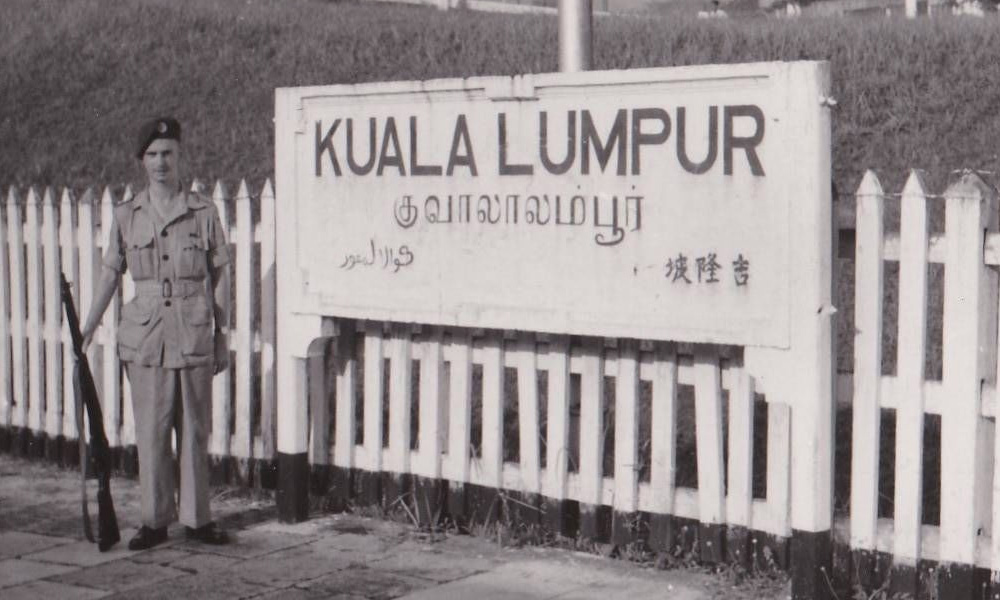
A British colonial soldier during the Malayan emergency
In Ipoh, the Naafi store was located on Jalan Ashby, overlooking the nearby Gurdwara Sahib Ashby.
When
the British army left in the 1960s to 1970s, they took their soldiers,
but left behind mess halls, officer canteens and structured templates
for professional conduct across the ranks.
Under Naafi,
socialising was regulated, breaches carried serious consequences, and
alcohol misuse, coercion of juniors, or unauthorised outsiders were not
tolerated.
Gaps in enforcement
The misconduct now described as yeye culture is not a continuation of that system; it emerged decades later due to gaps in enforcement and elite tolerance.
Early
Malaysian officers inherited these facilities and largely maintained
professional standards. Mess halls were used to build camaraderie,
morale, and unit cohesion, not excess.
After the British left,
tweaks were introduced to give the system a local flavour: alcohol was
removed, and family participation in social gatherings was encouraged.
Officers cannot fairly be blamed for later misconduct, because what changed was enforcement, not the social template.
Over time, rules remained on paper, but leadership tolerance widened the gap between policy and practice.
Yeye
culture emerged gradually, where certain conditions aligned: junior
officers were dependent on seniors for career advancement, questionable
behaviours were quietly tolerated, and power was concentrated at the
top, enabling selective enforcement.
Formally banned, but…
By
the time the practice was formally banned in 1998, it had already taken
root in some units. It was not formally sanctioned, but allowed to
persist.
Some explanations point to lapses in faith, moral
decline, or lingering colonial influence, but these are misleading.
Misconduct occurs when those with power feel immune to consequences.
The
Armed Forces Islamic Services Corps (Kagat), established in 1985, can
advise, counsel, and recommend action, but cannot punish.
Discipline starts at the top, and only commanding officers and generals have the authority to discipline personnel.
When
senior officers are themselves involved or choose to protect
colleagues, advisory or moral oversight by Kagat cannot compel action.
Enforcement depends on the willingness of those at the top, not on rules, reports, or ethical guidance alone.
Under fire
According to Malaysiakini reports, the “parti yeye”
culture has continued to plague the armed forces, despite the ban and
Kagat’s formation, highlighting the difficulty in cracking down when
high-ranking officers are implicated.
A screenshot of ‘parti yeye’
Retired brigadier-general Arshad Raji emphasised
that such events could only occur with the knowledge and consent of a
camp’s commanding officer, describing it as “impossible” for them to
claim ignorance.
He said, "What happened here (as alleged in viral claims) is not right. Do not turn officers’ mess halls into a whore house."
Even personal lives
suffer: Zhane, the ex-wife of a captain, said her marriage ended within
two years of her husband’s participation in wild parties.
She
addressed the failure of leadership and said, "It is all up to the
leadership of the battalion. If you get a boss who is good and cares
about the welfare of his officers and their families, it is a blessing."
The camp’s top brass knew, but chose not to act, despite her attempts to report the matter through proper channels.
Such tolerance at the top filters down the ranks by normalising behaviours that would otherwise be unacceptable.
Are
these incidents isolated? What do insiders reveal? What will trigger
enforcement? Did gatherings go unnoticed and were quietly tolerated
until social media exposure and incriminating photos forced action?
Military social spaces can exist
This culture of tolerance mirrors other challenges in the armed forces, including procurement scandals and misuse of welfare funds.
A former army chief and his two wives at the Putrajaya Magistrate’s Court recently
The
pattern is consistent: concentrated power weakens oversight, enables
selective enforcement, and erodes institutional credibility.
Order, by contrast, depends on effective oversight, accountability, and leadership.
Naafi is mentioned to provide context, not blame. It shows that similar social spaces can operate under strict discipline.
Today’s failures are post-colonial, structural, and leadership-driven; they are not historical, cultural, or religious.
Misconduct
thrives when power shields it. Discipline, integrity, and reform do not
rise from the bottom. They begin at the top, where authority holds
sway. This is not an attack on the armed forces; it is a defence of
professionalism.
The MACC has been investigating
military procurements since 2023, but that does not address decades of
tolerated misconduct and weak enforcement. Will the MACC investigate
earlier purchases?
So, until those in power are held responsible
for what occurs under their command, the cycle of tolerance and
misconduct will continue.