Rudyard Kipling"
“When you're left wounded on Afganistan's plains and
the women come out to cut up what remains, Just roll to your rifle
and blow out your brains,
And go to your God like a soldier”
General Douglas MacArthur"
“We are not retreating. We are advancing in another direction.”
“It is fatal to enter any war without the will to win it.” “Old soldiers never die; they just fade away.
“The soldier, above all other people, prays for peace, for he must suffer and be the deepest wounds and scars of war.”
“May God have mercy upon my enemies, because I won't .” “The object of war is not to die for your country but to make the other bastard die for his.
“Nobody ever defended, there is only attack and attack and attack some more.
“It is foolish and wrong to mourn the men who died. Rather we should thank God that such men lived.
The Soldier stood and faced God
Which must always come to pass
He hoped his shoes were shining
Just as bright as his brass
"Step forward you Soldier,
How shall I deal with you?
Have you always turned the other cheek?
To My Church have you been true?"
"No, Lord, I guess I ain't
Because those of us who carry guns
Can't always be a saint."
I've had to work on Sundays
And at times my talk was tough,
And sometimes I've been violent,
Because the world is awfully rough.
But, I never took a penny
That wasn't mine to keep.
Though I worked a lot of overtime
When the bills got just too steep,
The Soldier squared his shoulders and said
And I never passed a cry for help
Though at times I shook with fear,
And sometimes, God forgive me,
I've wept unmanly tears.
I know I don't deserve a place
Among the people here.
They never wanted me around
Except to calm their fears.
If you've a place for me here,
Lord, It needn't be so grand,
I never expected or had too much,
But if you don't, I'll understand."
There was silence all around the throne
Where the saints had often trod
As the Soldier waited quietly,
For the judgment of his God.
"Step forward now, you Soldier,
You've borne your burden well.
Walk peacefully on Heaven's streets,
You've done your time in Hell."
Citing an
example, Ranjit said mainstream history books virtually do not mention
the contributions of the Orang Asli community, who are the original
inhabitants of the country.
“They (Orang Asli) have virtually disappeared (from our history textbooks),” he lamented.
Citing
an example, he said that secondary school history books (2016 to 2020
editions) have no mention of the Orang Asli community except for the
Senoi Praaq, which is an Orang Asli police unit set up by the British
colonial administration to combat communists.
Ranjit reiterated
that while Orang Asli are the indigenous people of Peninsular Malaysia,
the Malays are “definitive people” of the land, who, across centuries,
have shaped West Malaysia’s political, cultural, and civilisational
identity.
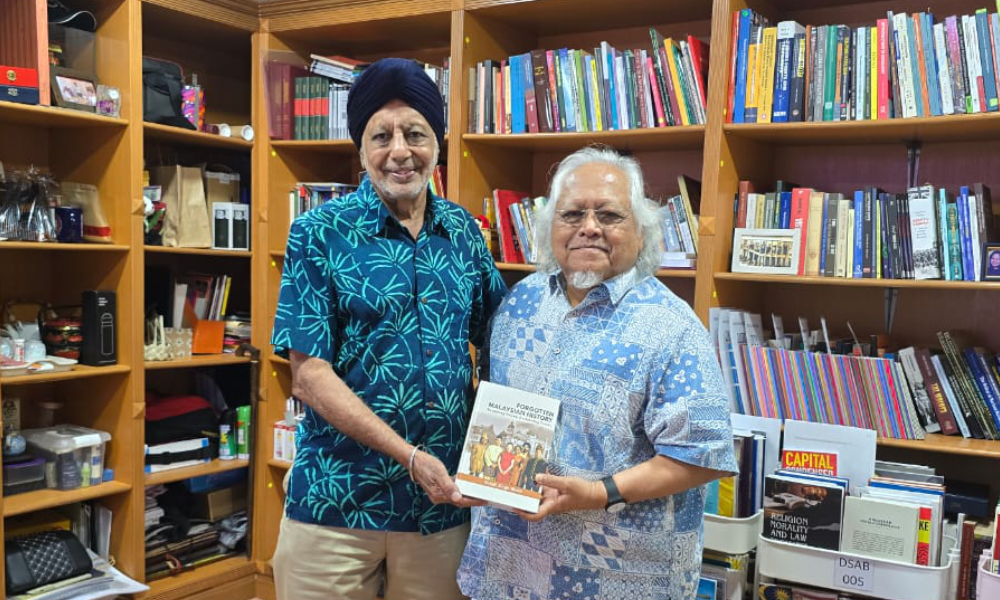
Historian Ranjit Singh Malhi (left) and UKM academic Shamsul Amri Baharuddin, who wrote the foreword for the book
However,
he did not mince his words when criticising ethno-nationalists,
accusing them of “weaponising history” to portray Malaysia as belonging
to a single ethnic group, often by framing others as “pendatang” (immigrants) in an attempt to deny their ancestors’ contribution to nation-building.
And
this is where, he added, his book would come in handy, “restoring
marginalised voices” by documenting the historical presence and
contributions of communities that have faded from mainstream accounts of
nation-building.
Welcome constructive dialogue
Beyond
correcting biased historical accounts, Ranjit said that his book is
also intended as an invitation to dialogue, particularly among
Malaysians who disagree with his views.
Asked
about how he plans to deal with right-wing groups and
ethno-nationalists who may disagree with his book, he said he would love
to hear their rebuttals as long as they are based on facts during
several roadshows he plans to organise in the coming months.
“I
want people to debate with me. Not on vague claims, but based on sources
and facts,” he stated, adding that confronting distorted readings of
the past is not merely an academic exercise but a necessary step towards
national unity and progress.
“How do we make our nation united,
progressive, and in line with the Rukun Negara? How do we move forward
as a nation? That’s the purpose of this book.
“Everybody played a role in forging this country called Malaysia,” he stressed.
Sense of belonging
However,
the seasoned historian pointed out that history is not only about facts
and dates, rather it also gives people a sense of place and belonging
to their country.
That sense of belonging, Ranjit added, is something Malaysia urgently needs to restore.
“I belong to this nation. My ancestors, forefathers, also contributed to this nation,” he added.
He
warned that failing to understand the past leaves the country
vulnerable to repeating the same mistakes made by its ancestors.
On
that note, Ranjit said that the country desperately needs leaders who
view Malaysians as “Bangsa Malaysia” (Malaysian race), rather than
through a narrow ethnic lens.
He emphasised that the nation’s
progress banks on the willingness of the people to move beyond
race-based politics and embrace a broader national identity.
“We
need a new breed of politicians who look at Malaysians as Bangsa
Malaysia… those who have the superordinate goal of making this a truly
united, meritocratic, and progressive nation.
“Malaysia badly needs politicians of that mould, of that calibre. Who serve, truly serve the people,” he said.
The
book, which took Ranjit five years of research and writing, spans 456
pages and includes over 250 high-quality historical photographs, and
will be translated into Malay next year.
Printed in a hardcover
edition with ivory pages, it is set to reach readers at an early bird
price until the end of December, making it accessible to readers who are
keen to explore Malaysia’s history.
Priced at RM100 for early birds, those interested can reach out to the author at ranjit@tqm.com.my.