Rudyard Kipling"
“When you're left wounded on Afganistan's plains and
the women come out to cut up what remains, Just roll to your rifle
and blow out your brains,
And go to your God like a soldier”
General Douglas MacArthur"
“We are not retreating. We are advancing in another direction.”
“It is fatal to enter any war without the will to win it.” “Old soldiers never die; they just fade away.
“The soldier, above all other people, prays for peace, for he must suffer and be the deepest wounds and scars of war.”
“May God have mercy upon my enemies, because I won't .” “The object of war is not to die for your country but to make the other bastard die for his.
“Nobody ever defended, there is only attack and attack and attack some more.
“It is foolish and wrong to mourn the men who died. Rather we should thank God that such men lived.
The Soldier stood and faced God
Which must always come to pass
He hoped his shoes were shining
Just as bright as his brass
"Step forward you Soldier,
How shall I deal with you?
Have you always turned the other cheek?
To My Church have you been true?"
"No, Lord, I guess I ain't
Because those of us who carry guns
Can't always be a saint."
I've had to work on Sundays
And at times my talk was tough,
And sometimes I've been violent,
Because the world is awfully rough.
But, I never took a penny
That wasn't mine to keep.
Though I worked a lot of overtime
When the bills got just too steep,
The Soldier squared his shoulders and said
And I never passed a cry for help
Though at times I shook with fear,
And sometimes, God forgive me,
I've wept unmanly tears.
I know I don't deserve a place
Among the people here.
They never wanted me around
Except to calm their fears.
If you've a place for me here,
Lord, It needn't be so grand,
I never expected or had too much,
But if you don't, I'll understand."
There was silence all around the throne
Where the saints had often trod
As the Soldier waited quietly,
For the judgment of his God.
"Step forward now, you Soldier,
You've borne your burden well.
Walk peacefully on Heaven's streets,
You've done your time in Hell."
Analysis: Has Anwar lost touch with reality on the ground? By Lee Way Loon
Thursday, December 11, 2025
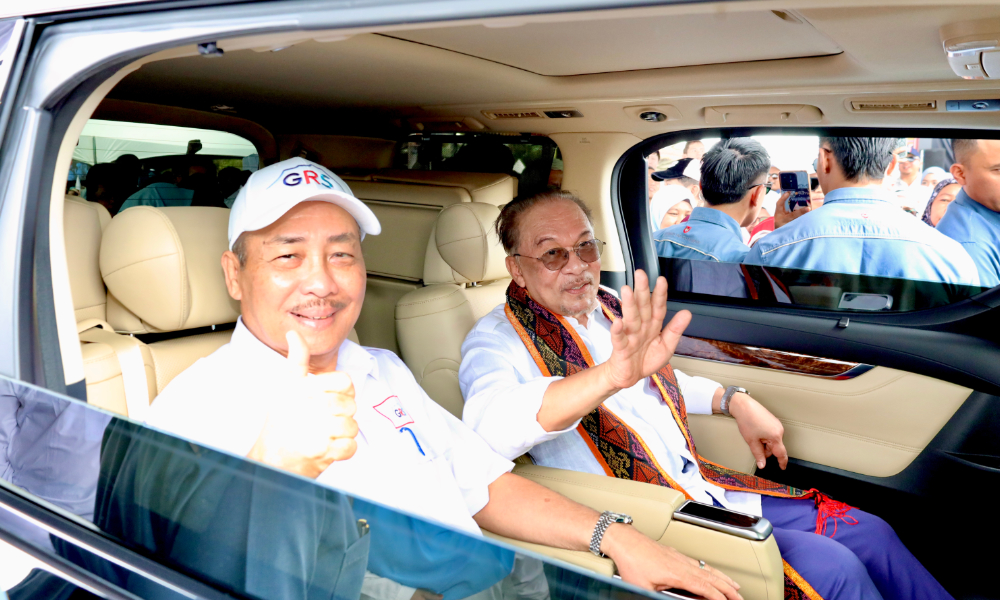
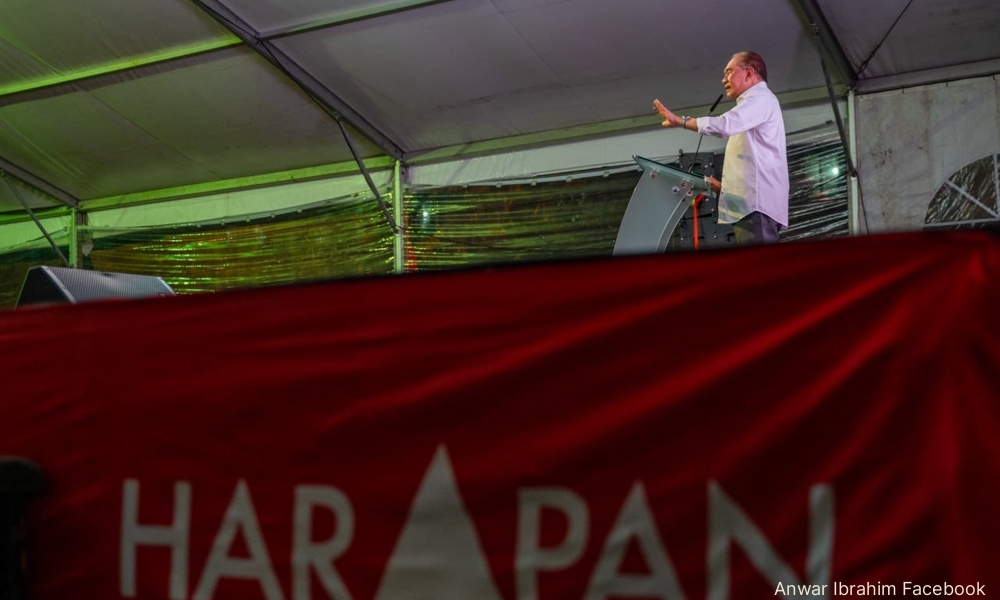
Malaysiakini : During the campaign period, Anwar also visited Hajiji's constituency to stumpfor him
despite the corruption scandals surrounding the chief minister, all of
which Hajiji has denied. Now, Hajiji has survived the election and
retained power, while his ally Harapan suffered a humiliating rout.
PM Anwar Ibrahim with Sabah CM Hajiji Noor
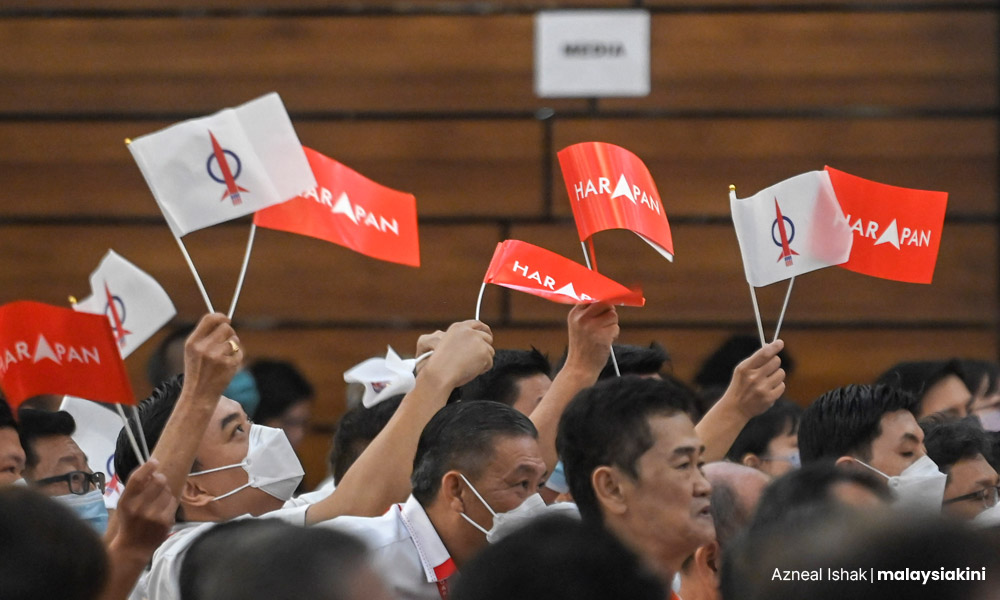
The election results were unequivocal: urban and Chinese voters largely abandoned Harapan. DAP was completely wiped out, and PKR also lost urban fortress seats like Api-Api, managing to win only one seat in Melalap - thanks to a candidate "borrowed" from Gagasan Rakyat Sabah before the election.
Against this backdrop, Anwar's beaming smile at his book launch naturally seemed ill-timed.
On
his Facebook, one particularly cutting comment played on the book's
title: “Come the next general election, I too will be ‘rethinking’.”
Similar sarcastic remarks could be found across the comment sections of various media outlets' social pages.
On Dec 2, Anwar attended a dinner banquet with government backbenchers. One attendee told Malaysiakini that he seemed "self-congratulatory", showing no signs of reflection. "He simply doesn't think he lost the election".
Reportedly, Anwar mentioned at the dinner that Chinese Malaysians were unhappy about excessive government aid to Palestine.
However,
even if this discontent exists - and even though some Chinese netizens
mock him as the "prime minister of Palestine" - this is hardly the only
reason Chinese voters abandoned Harapan.
Simmering discontent
Pakatan
Harapan won 82 seats in the 2022 general election, largely thanks to
strong support from the Chinese electorate, and formed a coalition
government with other parties.
Three years later, Malay support
has shown no significant improvement, while discontent among Chinese and
Indian communities has reached a boiling point.
Their discontent
isn't about a single issue, but an accumulation of grievances: broken
promises on reform and fighting corruption, policies perceived as
anti-business, identity politics, and more.
The Attorney-General's Chamber's decision in May to classify the Teoh Beng Hock case as "no further action", and subsequent developments further eroded the trust of Harapan's most loyal support base.
But the deeper emotion is one of "betrayal".
Supporters
have put Harapan in power twice, but now feel their support is taken
for granted while the coalition obsesses over competing with Perikatan
Nasional for conservative Malay votes, breeding resentment.
Harapan's
Chinese base has been remarkably tolerant. When the KK Mart incident
erupted in March 2024, the government's sluggish response and Umno Youth
chief Akmal Saleh's political theatrics generated enormous dissatisfaction.
Yet in the Kuala Kubu Baharu
by-election in May that year, the Chinese community rallied behind
Harapan and DAP once more when PN scored an own goal after PAS leaders
attacked Harapan candidate Pang Sock Tao's Chinese education background.
Two months later, in the Sungai Bakap by-election, the supporters' disappointment had become more evident, with PKR losing the election by more than 4,000 votes.
When Akmal led a protest at a hardware store in Penang over a flag incident in August, it proved to be the spark that ignited the Chinese and urban backlash in the Sabah election.
Anxious Harapan
In contrast to Anwar's relaxed attitude, DAP appeared deeply anxious.
For
DAP, which has its roots in the Chinese community, this election was
nothing short of a wake-up call. Post-election, DAP was filled with
anxiety and unease, worried that the Chinese backlash in Sabah would
spread to Peninsular Malaysia.
This
concern isn't limited to DAP. Some PKR MPs share similar worries: if a
Chinese backlash takes shape in the peninsula, not only DAP but also PKR
and Amanah would suffer devastating defeats in mixed constituencies -
even Anwar's own Tambun seat might not be safe.
Post-election, several PKR leaders have written articles demanding that the party address the collapse of its base.
Two
days after the election, DAP's central executive committee held an
emergency meeting, stating that "We have received a strong and
unmistakable message from the voters. It is undeniable that this
election reflects a serious crisis of confidence faced by both DAP and
Pakatan Harapan".
At the same time, DAP resolved to consolidate
feedback on public grievances and work with the prime minister to
accelerate the reform agenda over the next six months.
During the
meeting, there were also suggestions that if no reform results are seen
within six months, DAP should consider leaving the government, with
ministers and deputy ministers resigning to become backbenchers.
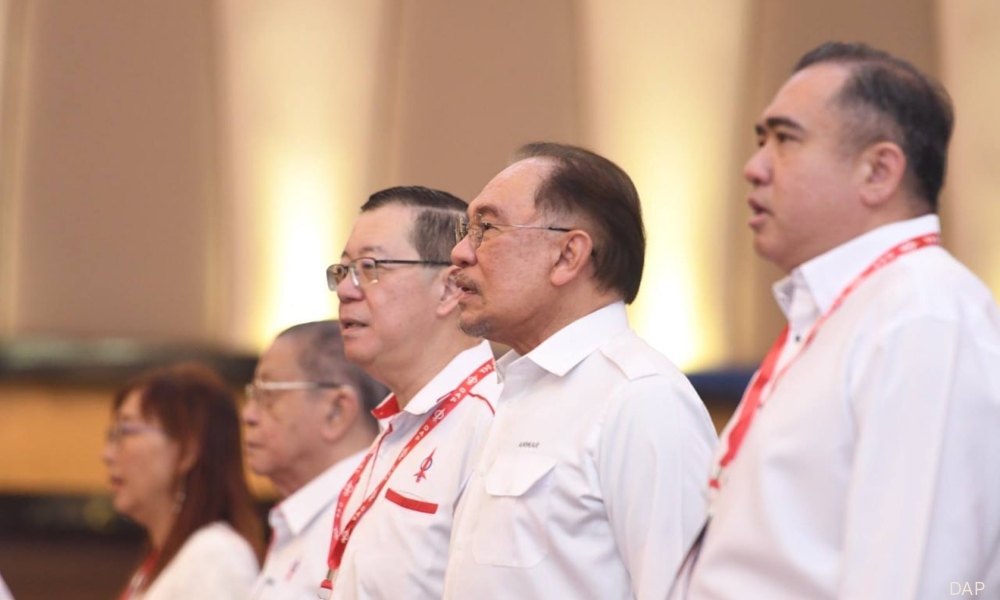
Anwar between DAP leaders Anthony Loke (right) and Lim Guan Eng
Party secretary-general Anthony Loke also confirmed that if no changes are seen during this period, DAP would review its position in the government.
While
DAP has not published a reform checklist, its deputy chairperson, Nga
Kor Ming, revealed this Monday that they would meet with Anwar to demand
recognition of the Unified Examination Certificate (UEC).
He even
called out to the Chinese community, saying that as a minority of only
22 percent of the population, Chinese Malaysians need to understand the
bigger picture and simply cannot afford to be divided. Otherwise,
"(ex-PM Dr) Mahathir (Mohamad) and PN’s PAS will be laughing at the
Chinese behind their backs".
This narrative undoubtedly highlights
the DAP leaders' anxieties and sounds as if they remain stuck in
another era, out of step with current realities.
Other DAP leaders like Gobind Singh Deo, Lim Guan Eng, and Ramkarpal Singh have also spoken out repeatedly on several issues.
Among them, Lim publicly urged
Anwar, who is also finance minister, to review the expanded scope of
the sales and service tax, the e-invoice policy, corporate tax refund
issues, and more.
Missing the mark
One week after the election, on Dec 6, Anwar made his first substantive response to the public backlash.
He announced that the e-invoice threshold
would be raised from RM500,000 to RM1 million, and that this year's tax
refund allocation would increase from RM2 billion to RM4 billion to
expedite processing of SME tax refund backlogs.
PKR's central
leadership committee also held a meeting on Monday to discuss the Sabah
defeat and the above policy adjustments, but the statement issued
afterwards was merely perfunctory, with no detailed examination of the
election loss.
Over the past two weeks, Anwar's posture still gives the impression that he doesn't understand the severity of the problem.
Relaxing
e-invoice requirements and expediting tax refunds are at best stop-gap
measures - necessary, but far from sufficient to address
long-accumulated public sentiment. If Anwar thinks he can win back
Chinese votes with just this, he is missing the bigger picture.
Some
Harapan leaders worry: Is Anwar living out the parable of "The
Emperor's New Clothes", only listening to sycophants around him, causing
his political judgment and administrative decisions to become
disconnected from public sentiment?
Or worse still, does Anwar
have no advisers or confidants, with decisions basically made on his
personal whim alone? One theory is that no one within Harapan knows who
is in Anwar's inner circle, and that even Home Minister Saifuddin
Nasution Ismail, who previously enjoyed Anwar's trust, is no longer part
of this.
The day before the election, the MACC conducted a dramatic raid and arrest of businessperson Albert Tei, which became the last straw that broke the urban voters' backs.
If
the operation had the prime minister's approval, it shows a disastrous
lack of political judgment. If not, it reveals the prime minister cannot
control the political tempo.
Meanwhile, cabinet vacancies have remained unfilled for extended periods.
After
Rafizi Ramli and Nik Nazmi Nik Ahmad resigned mid-year, no one was
appointed to fill their positions as economy minister and the natural
resources and environmental sustainability minister, respectively.
Early this month, Tengku Zafrul Abdul Aziz stepped down as the investment, trade and industry minister when his Senate term expired, and Upko president Ewon Benedick resigned as entrepreneur and cooperatives development minister before the Sabah election.
What
does this series of political and administrative missteps mean? Is it
Anwar's poor judgment? Or is he surrounded by a group of people who only
dare to say "the clothes look great"?
Or has Anwar become entranced by his own charm, indulging himself in a self-delusion of victory?