Rudyard Kipling"
“When you're left wounded on Afganistan's plains and
the women come out to cut up what remains, Just roll to your rifle
and blow out your brains,
And go to your God like a soldier”
General Douglas MacArthur"
“We are not retreating. We are advancing in another direction.”
“It is fatal to enter any war without the will to win it.” “Old soldiers never die; they just fade away.
“The soldier, above all other people, prays for peace, for he must suffer and be the deepest wounds and scars of war.”
“May God have mercy upon my enemies, because I won't .” “The object of war is not to die for your country but to make the other bastard die for his.
“Nobody ever defended, there is only attack and attack and attack some more.
“It is foolish and wrong to mourn the men who died. Rather we should thank God that such men lived.
The Soldier stood and faced God
Which must always come to pass
He hoped his shoes were shining
Just as bright as his brass
"Step forward you Soldier,
How shall I deal with you?
Have you always turned the other cheek?
To My Church have you been true?"
"No, Lord, I guess I ain't
Because those of us who carry guns
Can't always be a saint."
I've had to work on Sundays
And at times my talk was tough,
And sometimes I've been violent,
Because the world is awfully rough.
But, I never took a penny
That wasn't mine to keep.
Though I worked a lot of overtime
When the bills got just too steep,
The Soldier squared his shoulders and said
And I never passed a cry for help
Though at times I shook with fear,
And sometimes, God forgive me,
I've wept unmanly tears.
I know I don't deserve a place
Among the people here.
They never wanted me around
Except to calm their fears.
If you've a place for me here,
Lord, It needn't be so grand,
I never expected or had too much,
But if you don't, I'll understand."
There was silence all around the throne
Where the saints had often trod
As the Soldier waited quietly,
For the judgment of his God.
"Step forward now, you Soldier,
You've borne your burden well.
Walk peacefully on Heaven's streets,
You've done your time in Hell."
Six years after Sheraton Move, is Anwar safe? By Wong Chin Huat
Friday, February 27, 2026
Malaysiakini : Holding a parliamentary super-majority of 153 seats (69 percent),
Anwar can serve until the end of the 15th Parliament, Dec 18, 2027, if
he does not seek early dissolution. There is no imminent risk of midterm
collapse for Anwar, as Mahathir inflicted on himself.
To
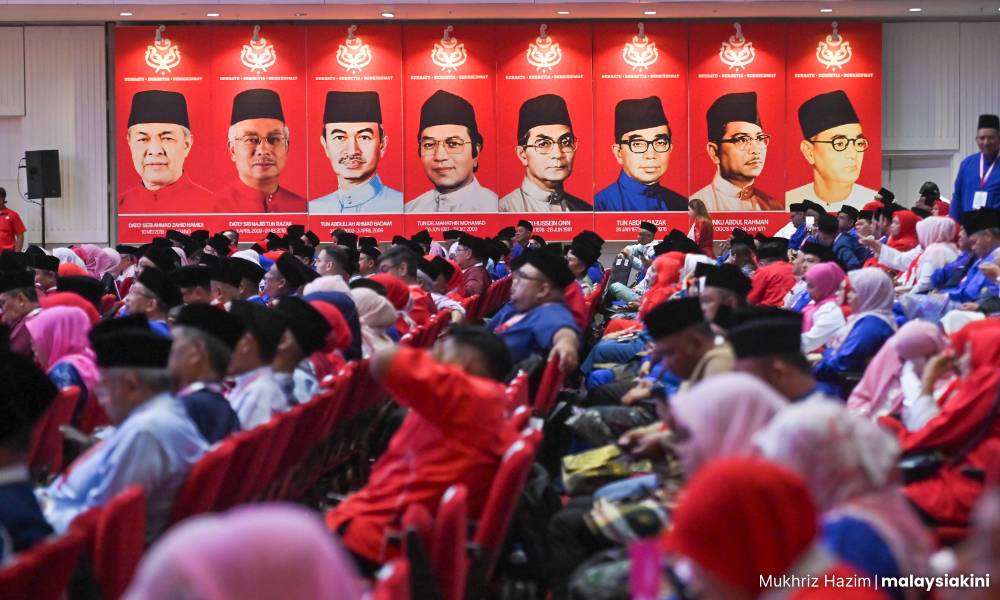
surpass Abdul Razak Hussein, Hussein Onn, and Abdullah Ahmad Badawi in
duration, he would have to win the GE16. Harapan must win a clear
plurality over other blocs, not just for the whole of Malaysia, but in
Peninsular Malaysia too, where it won 75 seats in 2022.
To be safe, Harapan needs to win over 70 peninsula seats. Can Anwar do it? This column examines several factors.
Opposition disarray
On
the surface, some would say it is a no-brainer. Under the Madani
government, Malaysia is now enjoying both economic growth and political
stability. In contrast, Bersatu is split, with now 11 out of its 31 MPs ousted from the party, and Perikatan Nasional is in decline and might be operationally reduced to PAS.
PN is the fifth opposition coalition that sank into decline or demise after losing one or two general elections.
The
list started with Tengku Razaleigh Hamzah’s two-in-one bloc, Gagasan
Rakyat-Angkatan Perpaduan Ummah, which folded up in 1995 and 1996,
Anwar’s first vehicle Barisan Alternatif, which was effectively dormant
by 2004, Anwar’s second vehicle Pakatan Rakyat, which officially ended
in 2015, and BN, which was practically reduced to peninsula Umno after
2018.
Beyond the personality factor, opposition coalitions
disintegrated or declined because once the prospect of winning or
returning to power is lost, the incentives for component parties to
stick together gradually disappear.
The diminishing electoral
prospect can even be personal when opposition lawmakers are denied
constituency allocation to help needy constituents.
Built over six
decades by Umno, Malaysia’s winner-takes-all and patronage-heavy
political structure systematically depletes the losers to ensure a
dominant party.
Ethnic tensions
However,
dominance does not ensure stability. What do you do if you are an
opposition party with no chance to win power? You focus on winning seats
by electrifying your communal/regional vote bank, who are more
responsive to identity issues than policy matters.
In its heydays,
BN - Umno and its non-Malay allies - were simultaneously accused of
selling out the Malay-Muslims (by PAS) and marginalising the minorities
(by DAP).
In
the 22 months after GE14, Umno and PAS formed Muafakat Nasional and
attacked Harapan on ethnicity, religion and language, riding the
anti-Icerd wave and later benefitting from Harapan’s mismanagement of
the Jawi issue, which alienated both the Malays and non-Malays.
Hence,
it would be naïve to think the GE16 would be a walk in the park for
Harapan and its allies. If the opposition is convinced that they have no
chance to win votes and seats beyond their hardcore supporters, then
the most rational strategy is to make GE16 a negative competition with
smears and hatred, making it hard for a centrist government to play its
balancing act.
The goals are simple: (a) getting the non-Malays
and liberals to think they are being taken for granted by Anwar (so that
they might abstain), (b) getting more Malays to feel threatened or just
irritated by DAP or non-Malays (so that they might vote PN or abstain),
and (c) getting middle ground voters to get frustrated or disillusioned
(so that they too might abstain).
And what better issues than
Hindu temples and pig farms? Expect these two to continue hogging news
headlines, unless Anwar seriously finds solutions to “de-weaponise”
them.
Corruption and reform
For voters who
see beyond or are less affected by ethno-religious tension, the trust
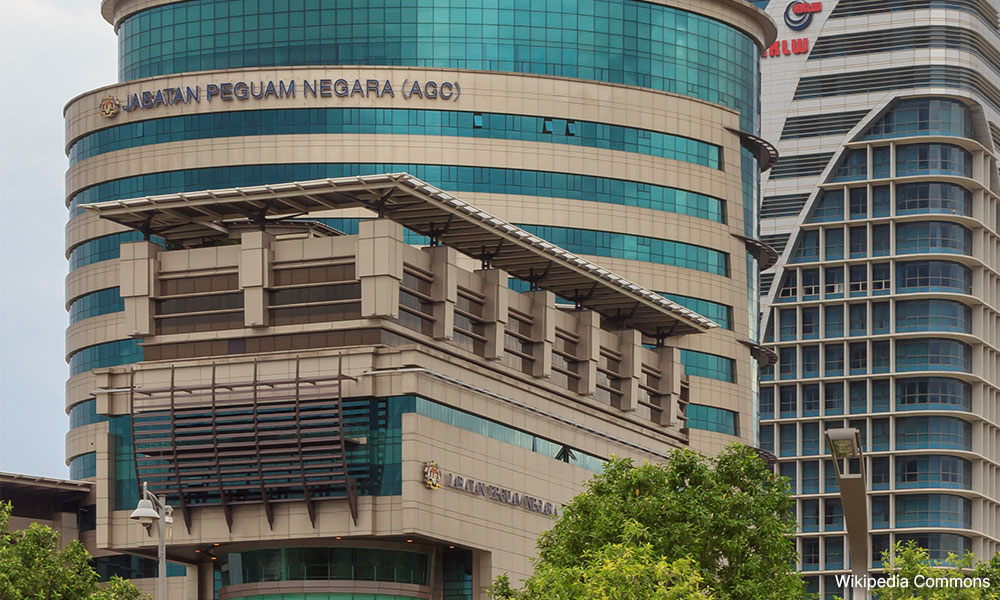
deficit is now centred on MACC chief commissioner Azam Baki and the
separation of the attorney-general and public prosecutor.
The cabinet’s decision to form a committee headed by Attorney-General Dusuki Mokhtar, who was personally involved in the withdrawal of charges against Deputy Prime Minister Ahmad Zahid Hamidi, to investigate only Azam’s shareholding in public listed companies but not allegations of MACC’s collusion in economic extortion, suggests extremely poor political judgment or worse, extreme political arrogance.
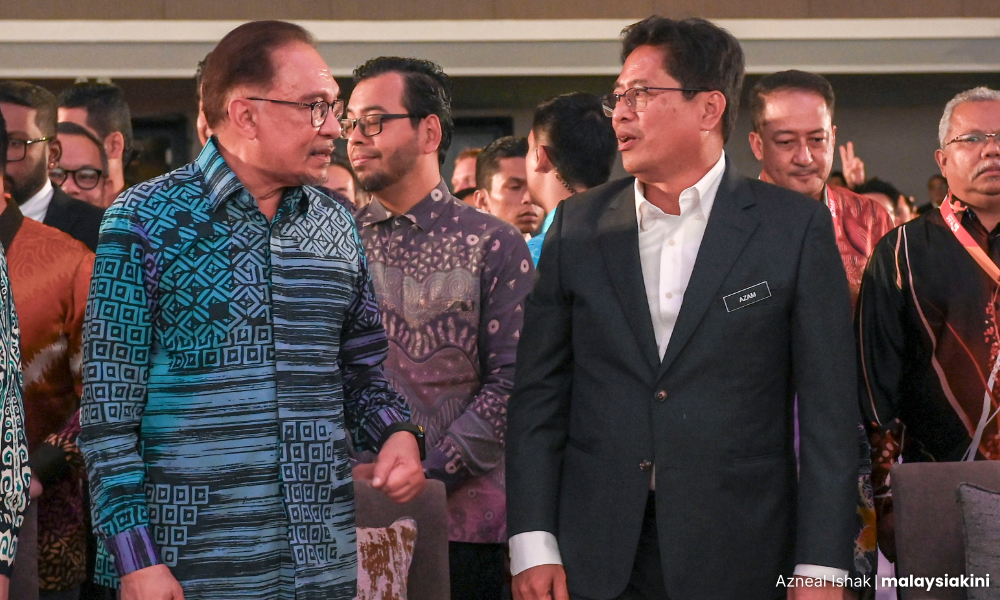
Prime Minister Anwar Ibrahim and MACC chief commissioner Azam Baki
If
the allegations are true, this is not just about Anwar using a tainted
man to pursue corrupt politicians and generals; it is about allowing the
MACC top brass to turn the anti-graft agency into an extortion racket,
akin to allowing police to control the underworld.
With Azam
linked to Anwar’s former aide and widely perceived money man Farhash
Wafa Salvador Rizal Mubarak, and to the GRS Sabah state government, a
for-show-only investigation is pushing reform-minded voters and decent
businesspeople to the corner.
Voting for Anwar in GE16 would be incredibly difficult for them because “the evil” would not be visibly “lesser”.
Azam’s
scandal is structural, not personal. He is a powerful unelected officer
appointed by and answerable only to the prime minister. As long as he
is a “court favourite”, he can act with little restraint. And as long as
he does the prime minister’s bidding, he can stay powerful.
This
incentivises a structurally symbiotic relationship between the prime
minister and the MACC chief commissioner and the resulting institutional
decadence.
Another powerful yet unaccountable high office is the
attorney-general, whose power is constitutionally enshrined under
Article 145. This is why Malaysians demand the separation of AG and PP,
and this is why the Constitutional Amendment Bill on Article 145
horrifies reform advocates and experts.
The AG-PP separation, if
passed in the current format, would not create an independent and
Parliament-accountable office of public prosecutor. It would only create
a new unelected office whose officer bearer has the potential to be
another monster who preys on citizens and businesses, hounds the enemies
of his/her political master, or both.
Instead
of an appointment with parliamentary input and exclusion of executive
influence, the public prosecutor would be appointed by the Yang
di-Pertuan Agong on the recommendation of the Judicial and Legal Service
Commission (JLSC) and after consultation with the Conference of Rulers.
The chronic problem with the attorney-general is not resolved but repackaged with even more complications.
First,
the new composition of JLSC includes the attorney-general (as long as
s/he is not an MP), who represents the executive interest in the
appointment of the public prosecutor, who, in turn, gets to influence
the appointment of lower court judges and high court registrars.
Second,
the appointment by the king might be construed as discretionary, which
then risks exposing the institution of the Yang di-Pertuan Agong to
suspicion, distrust, and attacks that any prime minister faces for
holding the power to effectively appoint the attorney-general.
This is politicising and undermining the constitutional monarchy as a key pillar of Malaysia’s parliamentary democracy.
A
simpler and better option would be splitting the JLSC into two separate
commissions for the judicial and prosecutorial services and granting
Parliament a filtering role in the PP nomination and an ongoing
scrutinising role in prosecutorial conduct, as civil society groups and
experts suggest.
Ditch Umno’s majoritarian playbook
Notwithstanding
significant reform initiatives, including the prime minister's 10-year
tenure and the AG-PP separation, Anwar appears to have been employing
much of the old playbook in Umno’s statecraft, from discriminating
against opposition parliamentarians to covertly maintaining executive
control even in the separated office of the public prosecutor.
Umno’s
old playbook embodies majoritarianism and power concentration, which
have both led to corruption and Umno’s ouster on one hand, and fuelled
Malays’ communal anxiety on the other hand.
If Anwar wants to win
his second term, he must ditch the old playbook and deliver true reforms
that can better stabilise Malaysia’s politics. If that playbook had
worked for Mahathir for the first time for 22 years, it did not last him
beyond 22 months for the second time. Malaysia has moved on.
Anwar
has been bold enough to introduce the 10-year tenure limit, something
which Mahathir would never do; he must now move further from Mahathir’s
shadow.
He shoul immediately put Azam on leave, appoint Tengku Maimun Tuan Mat
to lead a truly independent panel to investigate all allegations
against Azam and refer the constitutional bill on AG-PP separation to a
Parliamentary Select Committee for refinements.
That’s how he may reclaim the reformasi brand and not let it become Rafizi Ramli’s.