Rudyard Kipling"
“When you're left wounded on Afganistan's plains and
the women come out to cut up what remains, Just roll to your rifle
and blow out your brains,
And go to your God like a soldier”
General Douglas MacArthur"
“We are not retreating. We are advancing in another direction.”
“It is fatal to enter any war without the will to win it.” “Old soldiers never die; they just fade away.
“The soldier, above all other people, prays for peace, for he must suffer and be the deepest wounds and scars of war.”
“May God have mercy upon my enemies, because I won't .” “The object of war is not to die for your country but to make the other bastard die for his.
“Nobody ever defended, there is only attack and attack and attack some more.
“It is foolish and wrong to mourn the men who died. Rather we should thank God that such men lived.
The Soldier stood and faced God
Which must always come to pass
He hoped his shoes were shining
Just as bright as his brass
"Step forward you Soldier,
How shall I deal with you?
Have you always turned the other cheek?
To My Church have you been true?"
"No, Lord, I guess I ain't
Because those of us who carry guns
Can't always be a saint."
I've had to work on Sundays
And at times my talk was tough,
And sometimes I've been violent,
Because the world is awfully rough.
But, I never took a penny
That wasn't mine to keep.
Though I worked a lot of overtime
When the bills got just too steep,
The Soldier squared his shoulders and said
And I never passed a cry for help
Though at times I shook with fear,
And sometimes, God forgive me,
I've wept unmanly tears.
I know I don't deserve a place
Among the people here.
They never wanted me around
Except to calm their fears.
If you've a place for me here,
Lord, It needn't be so grand,
I never expected or had too much,
But if you don't, I'll understand."
There was silence all around the throne
Where the saints had often trod
As the Soldier waited quietly,
For the judgment of his God.
"Step forward now, you Soldier,
You've borne your burden well.
Walk peacefully on Heaven's streets,
You've done your time in Hell."
COMMENT - This was never about Puad By Mariam Mokhtar
Sunday, June 28, 2026
Malaysiakini : Within hours of Puad’s allegations regarding royal influence in Johor
political affairs, the discussion shifted with familiar speed. Police reports were made. Investigations began. Public debate hardened.
Almost
immediately, the focus moved away from the constitutional question,
which is the central issue he raised, and shifted instead to his
motives.
Motive besides the point
Was he bitter? Was he denied political reward? Was this internal party frustration repackaged as a principle?
This
was never about whether Puad was right or wrong. It was about whether
the constitutional question he raised could be openly discussed at all.
What is striking is not disagreement, but how disagreement is handled.
Instead of confronting the constitutional issue, the instinct is to dissect the man himself: ambition, resentment, opportunism, disloyalty.
The individual becomes the story. The institution vanishes.
This
may be politically effective, but it is constitutionally corrosive
because it teaches repeatedly that sensitive questions are not answered.
They are neutralised.
Johor
is widely discussed in public reporting as a state where the boundary
between constitutional form and political reality is not always easy to
separate.
Past
changes in menteri besar leadership and public statements from both
political and royal figures have reinforced a perception that political
outcomes cannot always be understood through electoral arithmetic alone.
Whether
one sees this as constitutional discretion or political influence
depends on interpretation. But what matters is this: the lack of shared
clarity has become part of the political environment itself.
Thus, where clarity is absent, perception fills the space.
Silence doesn’t resolve anything
It is essential to separate two things.
First,
the truth or falsity of any individual allegation, including those made
in current political disputes, is a matter for evidence, institutions,
and due process.
Second, and more important here, is the
structural issue: how constitutional questions are handled in public
life once they are raised.
Our discussion is about the second.
History shows that when direct criticism becomes difficult, it does not vanish, but it changes form.
Jonathan
Swift’s “Gulliver’s Travels” is a classic example. Beneath its
fictional worlds and absurd rulers lay a sharp critique of political
systems and human authority, expressed in metaphor because direct
language carried risk in its time.
Allegory became the language of survival.
Then, as now, people turned to satire and allegory not out of comfort, but out of caution and self-protection.
In
recent years, individuals who raised sensitive political or
constitutional questions faced investigations or legal consequences.
The case of activist Ali Abdul Jalil, who later left Malaysia and sought asylum in Sweden, is frequently cited in this context.
Walking on eggshells
Whether one agrees with his views is secondary.
The
constitutional issue is the perception such cases create: that certain
topics carry consequences beyond normal political disagreement.
When that perception spreads, speech does not disappear. It narrows.
Ordinary
citizens who raise complaints involving powerful individuals or
sensitive institutions often find themselves unsure of the consequences
of speaking out, not only about their complaint, but about themselves.
What matters is not consistency, but perception: that some lines feel riskier to cross than others.
And where that perception takes hold, participation shrinks.
In pre-revolutionary France, criticism of royal authority could lead to imprisonment or accusations of treason.
The problem was not only suppression itself, but the absence of safe, legitimate channels for grievance.
Over time, unresolved pressure did not disappear. It accumulated.
Systems that cannot absorb criticism do not become stronger. They become brittle.
Tensions will continue unless resolved
This is why the Puad episode matters, not because of Puad himself, but because of the pattern it reflects.
A constitutional question is raised. It becomes personal. Then moral. Then political. Then it disappears.
The
immediate issue is contained. The underlying ambiguity remains, but it
will return, disguised in another case and another controversy.
Puad
may be right. He may be wrong. He may be acting from conviction or
calculation, but none of that resolves the issue, because the problem is
not the individual.
It is the absence of a shared, explicit understanding of how constitutional monarchy and political authority interact in practice.
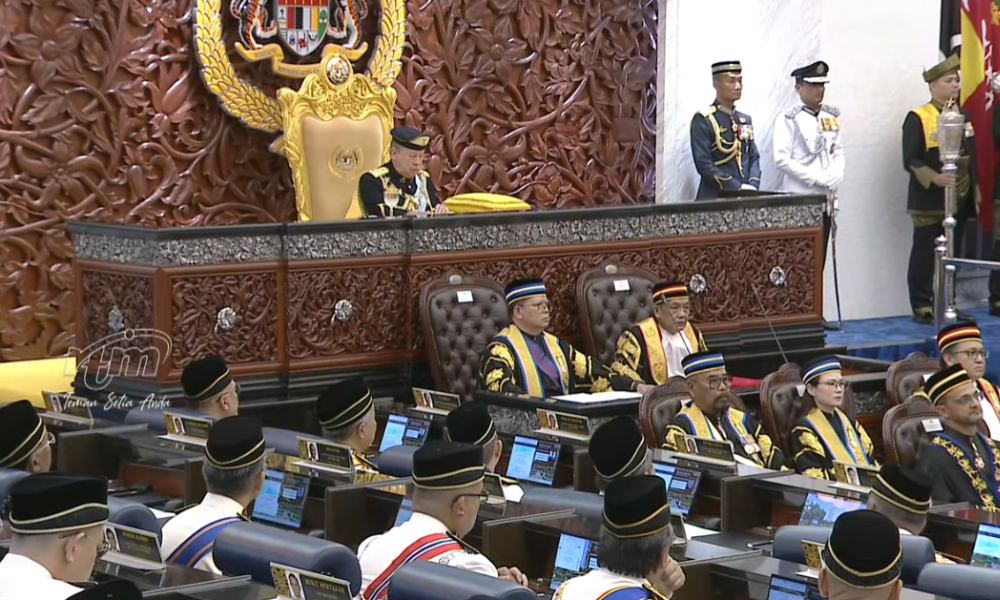
Yang di-Pertuan Agong Sultan Ibrahim Sultan Iskandar opening a session of Parliament On Jan 26, 2026
So,
until that question is addressed openly, this will repeat with
different names and different triggers, albeit with the same structure.
Constitutional ambiguity does not disappear when avoided, but it returns when tested.
The moment the debate became centred on Puad the man, the constitutional question had already been lost.