Rudyard Kipling"
“When you're left wounded on Afganistan's plains and
the women come out to cut up what remains, Just roll to your rifle
and blow out your brains,
And go to your God like a soldier”
General Douglas MacArthur"
“We are not retreating. We are advancing in another direction.”
“It is fatal to enter any war without the will to win it.” “Old soldiers never die; they just fade away.
“The soldier, above all other people, prays for peace, for he must suffer and be the deepest wounds and scars of war.”
“May God have mercy upon my enemies, because I won't .” “The object of war is not to die for your country but to make the other bastard die for his.
“Nobody ever defended, there is only attack and attack and attack some more.
“It is foolish and wrong to mourn the men who died. Rather we should thank God that such men lived.
The Soldier stood and faced God
Which must always come to pass
He hoped his shoes were shining
Just as bright as his brass
"Step forward you Soldier,
How shall I deal with you?
Have you always turned the other cheek?
To My Church have you been true?"
"No, Lord, I guess I ain't
Because those of us who carry guns
Can't always be a saint."
I've had to work on Sundays
And at times my talk was tough,
And sometimes I've been violent,
Because the world is awfully rough.
But, I never took a penny
That wasn't mine to keep.
Though I worked a lot of overtime
When the bills got just too steep,
The Soldier squared his shoulders and said
And I never passed a cry for help
Though at times I shook with fear,
And sometimes, God forgive me,
I've wept unmanly tears.
I know I don't deserve a place
Among the people here.
They never wanted me around
Except to calm their fears.
If you've a place for me here,
Lord, It needn't be so grand,
I never expected or had too much,
But if you don't, I'll understand."
There was silence all around the throne
Where the saints had often trod
As the Soldier waited quietly,
For the judgment of his God.
"Step forward now, you Soldier,
You've borne your burden well.
Walk peacefully on Heaven's streets,
You've done your time in Hell."
COMMENT - Bangsa Malaysia: Building one nation with a shared destiny By Ranjit Singh Malhi
Sunday, May 10, 2026
Malaysiakini : Malaysia cannot afford such a drift. The time has come to articulate,
with clarity and conviction, a unifying national vision - one that
reflects our constitutional foundations, honours our diversity, and
inspires collective purpose.
That vision is Bangsa Malaysia.
Bangsa
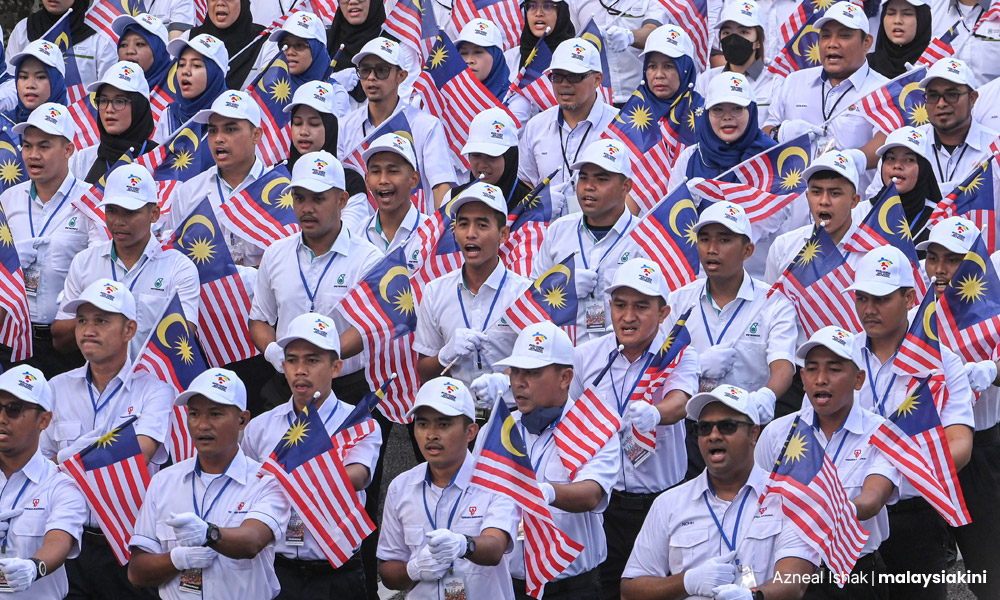
Malaysia is not a slogan. Nor is it an attempt to erase ethnic,
cultural, or religious identities. Malaysia’s diversity is a historical
reality and a national asset.
Bangsa Malaysia means building a
higher and shared national identity that binds Orang Asli, Malays,
Chinese, Indians, the indigenous peoples of Sabah and Sarawak, and other
ethnicities into one national community. It means seeing ourselves
first and foremost as Malaysians, while remaining proud of our
respective cultural and religious inheritances.
This idea is not new. It is rooted in the aspirations of our founding fathers and the Malay rulers at the dawn of independence.
The
constitutional framework that emerged from the 1956-57 intercommunal
bargain reflected a delicate but principled balance. It recognised the
special position of the Malays as the “definitive people” of the land,
while safeguarding the legitimate interests of other communities.
It
also envisaged a future in which Malaya, and later Malaysia, would
evolve towards greater fairness, inclusivity, and national unity.
Aspirations of political figures
It is worth recalling the words of Dr Ismail Abdul Rahman, one of Malaysia’s finest statespersons, who reportedly declared: “Kita
bukan bermaksud untuk mendirikan sebuah Malay-Malaysia, tetapi Malaysia
yang dipunyai serta diwarisi oleh semua warganegara tanpa mengira kaum
dan agama” (We do not intend to establish a Malay-Malaysia, but a
Malaysia that is owned and inherited by all citizens regardless of race
and religion) (Utusan Malaysia, Aug 4, 1973).
That remains one of the clearest and most profound expressions of the spirit of Bangsa Malaysia.
Likewise,
Nik Abdul Aziz Nik Mat, the longest-serving menteri besar of Kelantan,
stood for a humane and inclusive understanding of social justice. He
advocated that government assistance should reach all the poor,
regardless of race (The Malaysian Insider, March 1, 2009). This is the kind of moral clarity Malaysia urgently needs today.
For
the sake of future generations, Malaysia requires not merely reform,
but a national reset and a profound mental revolution: from narrow
communal politics to genuine national unity; from religious extremism to
constitutional governance; from religious domination to mutual respect;
from mediocrity to excellence; and from an obsession with numbers to a
culture of quality, integrity, and competence.
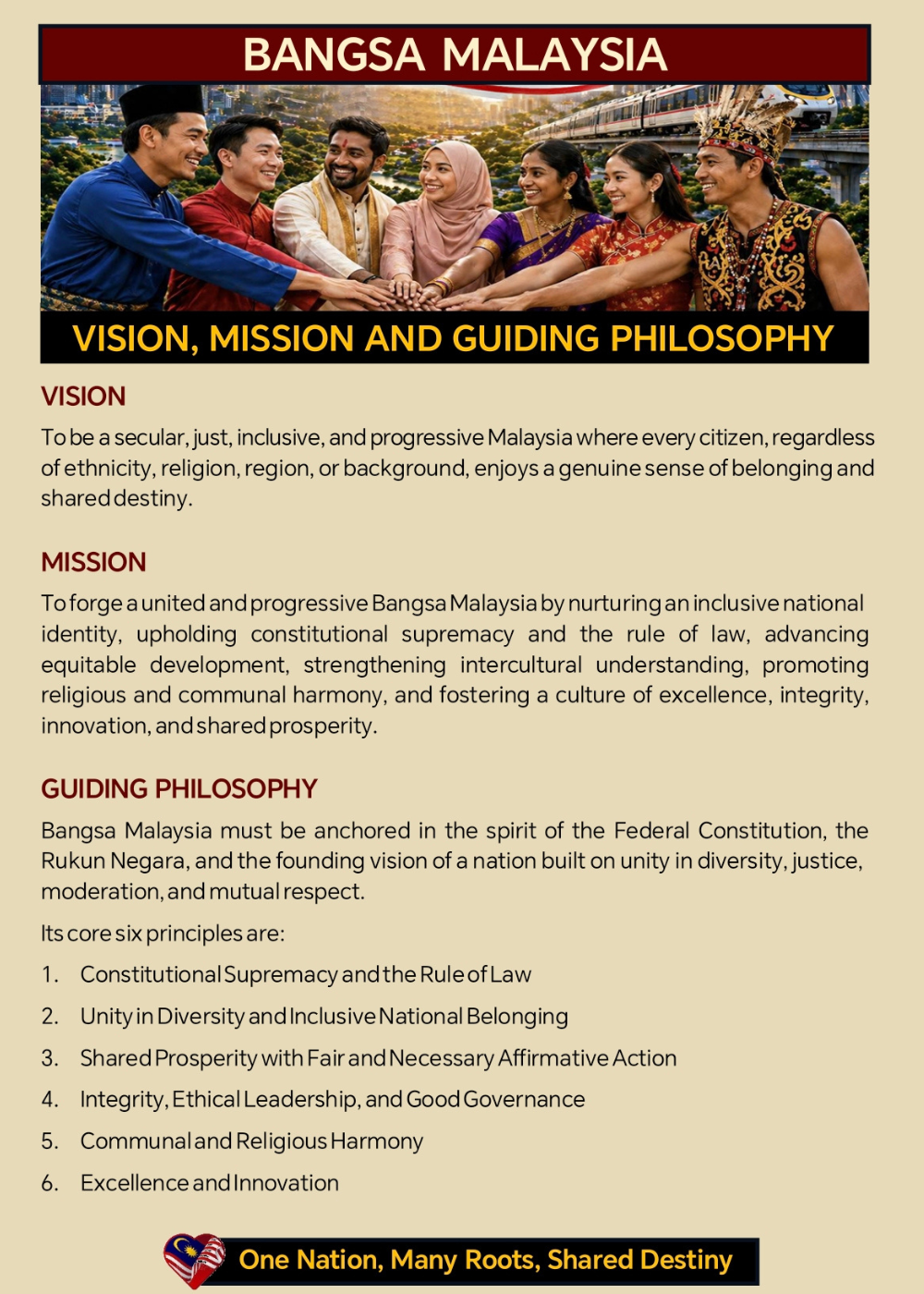
The
proposed vision, mission, and guiding philosophy for Bangsa Malaysia
are outlined below. Together, they define the desired future state of
our beloved nation, the key pathways towards attaining that vision, and
the guiding principles for building a united, just, and forward-looking
Malaysia.
But vision without implementation is mere rhetoric. The real question is: how do we put Bangsa Malaysia into action?
Steps towards unity
First,
Malaysia needs a Bangsa Malaysia Action Group comprising respected
multi-ethnic intellectuals, educators, historians, constitutional
scholars, community leaders, youth representatives, religious leaders,
professionals, business leaders, and civil society activists.
This
group should not be party-political. Its role should be to develop
practical programmes, public statements, educational materials, forums,
videos, community dialogues, and policy proposals aimed at strengthening
national unity.
Second, this action group should prepare a
People’s Charter for Bangsa Malaysia - a concise declaration affirming
constitutionalism, unity in diversity, religious moderation, fairness,
shared prosperity, and equal national belonging. Malaysians from all
communities should be invited to endorse it.
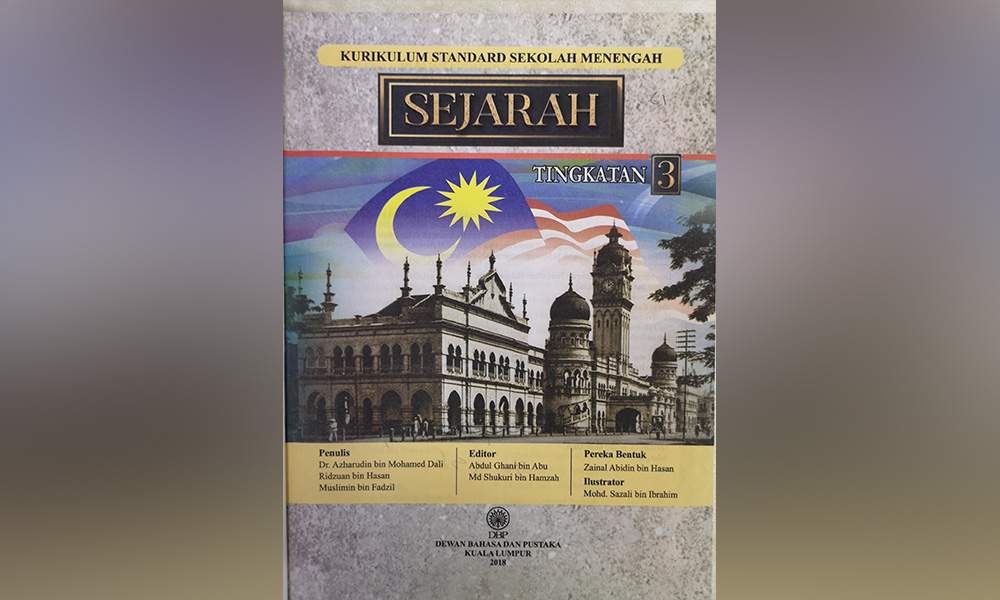
Third, we must reform
how history is taught and understood. Our history must be truthful,
inclusive, and evidence-based. It must recognise the contributions of
all communities - Malays, Orang Asli, Chinese, Indians, indigenous
peoples of Sabah and Sarawak, and other ethnic groups - to
nation-building.
A
selective, exclusionary, or distorted national narrative weakens unity
and undermines national belonging. A truthful and inclusive history
strengthens belonging.
Fourth, intercultural engagement must move
beyond formal ceremonies. Malaysia should revive and reimagine
neighbourhood-based unity groups, similar in spirit to Rukun Tetangga,
but with a stronger focus on communal harmony, civic education,
community service, and interfaith understanding.
These groups can
organise neighbourhood meals, youth projects, cultural exchanges,
history talks, sports activities, community clean-ups, and dialogues on
shared Malaysian values.
Education, religion, and theeconomy
Fifth,
schools and universities must become laboratories of Bangsa Malaysia.
Students should be encouraged to participate in mixed-group projects,
service-learning activities, heritage walks, debates, and inter-school
unity programmes.
Young Malaysians must not grow up in ethnic silos. They must learn to see one another as fellow citizens with a shared destiny.
Sixth,
religious and community leaders must play a constructive role. They
should publicly reject extremism, hate speech, and communal
demonisation. Places of worship can also become bridges of understanding
by hosting interfaith visits, charity drives, and community solidarity
programmes.
Seventh, economic justice must be pursued with wisdom
and fairness. Affirmative action needs to be recalibrated to help all
poor and marginalised Malaysians, regardless of ethnicity or religion,
while recognising the special challenges faced by the Malays, Orang
Asli, and the natives of Sabah and Sarawak.
Eighth, the media and
social media influencers must help shape a new national consciousness.
Short videos, articles, podcasts, posters, WhatsApp messages, and public
campaigns should promote the idea that Malaysia belongs to all
Malaysians.
We must make unity more compelling than division, and truth more powerful than propaganda.
Ninth,
corporate Malaysia should support Bangsa Malaysia through workplace
diversity, fair employment practices, leadership development,
scholarships, internships, and community outreach. Companies must not
merely speak of inclusion; they must practise it.
Finally,
ordinary citizens must take ownership of this national project. Bangsa
Malaysia begins in everyday life - in how we speak, how we vote, how we
teach our children, how we treat our neighbours, and how we respond to
divisive rhetoric.
Fundamental truths about our independence
Nation-building
is not the responsibility of politicians alone. Indeed, we cannot
depend entirely on politicians, many of whom remain trapped in communal
calculations and short-term self-interest.
Right-thinking
Malaysians from all communities must therefore come together with
courage, wisdom, sincerity, and a shared sense of national purpose. We
must reject narratives that divide and embrace values that unite. We
must act with fairness, integrity, and respect.
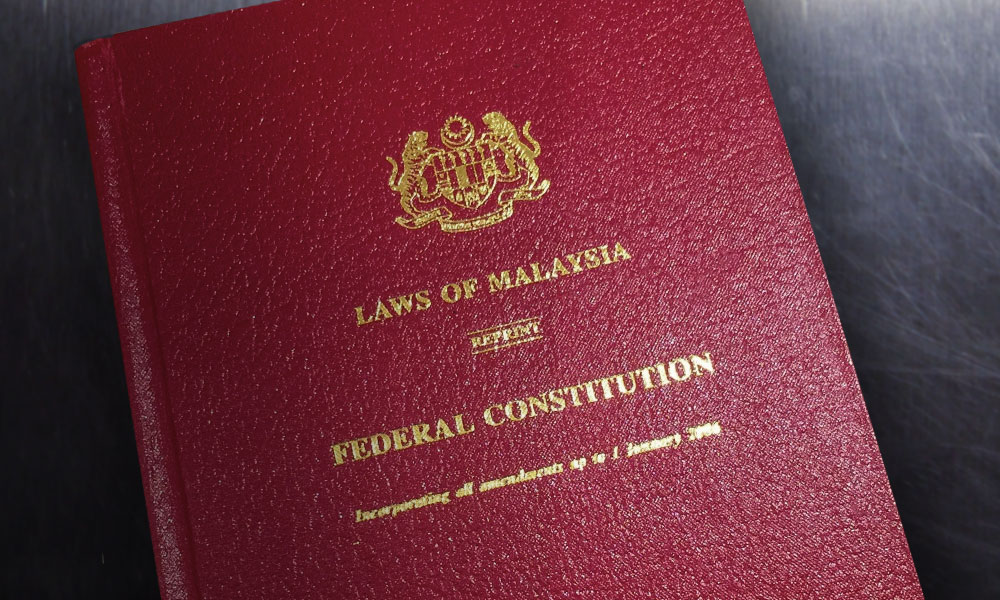
Above all, we must
recognise three fundamental truths about the intercommunal bargain of
1956-57 as clearly expressed in the 1957 Report of The Federation of
Malaya Constitutional Commission.
First,
our nation is meant to be secular. Second, the special position of the
Malays, which was never meant to be permanent, should be reviewed from
time to time. Third, there should be “no discrimination between races or
communities” in the long run.
The time has come to move beyond
rhetoric and rediscover the larger national purpose envisioned by our
founding fathers and the Malay rulers.
Let us move forward
together - not as fragmented communities defined by suspicion and fear,
but as one people bound by a shared Constitution, common values, and a
collective destiny.
In the final analysis, Malaysia’s future will
not be determined by what divides us, but by whether we possess the
wisdom and courage to strengthen what unites us.
The choice before
us is clear: we can continue drifting through communal politics and
national uncertainty, or we can rise together with clarity, conviction,
and purpose to build a truly united, just, and progressive Bangsa
Malaysia.
Let us choose wisely – for ourselves, for our children, and for generations yet unborn.