Rudyard Kipling"
“When you're left wounded on Afganistan's plains and
the women come out to cut up what remains, Just roll to your rifle
and blow out your brains,
And go to your God like a soldier”
General Douglas MacArthur"
“We are not retreating. We are advancing in another direction.”
“It is fatal to enter any war without the will to win it.” “Old soldiers never die; they just fade away.
“The soldier, above all other people, prays for peace, for he must suffer and be the deepest wounds and scars of war.”
“May God have mercy upon my enemies, because I won't .” “The object of war is not to die for your country but to make the other bastard die for his.
“Nobody ever defended, there is only attack and attack and attack some more.
“It is foolish and wrong to mourn the men who died. Rather we should thank God that such men lived.
The Soldier stood and faced God
Which must always come to pass
He hoped his shoes were shining
Just as bright as his brass
"Step forward you Soldier,
How shall I deal with you?
Have you always turned the other cheek?
To My Church have you been true?"
"No, Lord, I guess I ain't
Because those of us who carry guns
Can't always be a saint."
I've had to work on Sundays
And at times my talk was tough,
And sometimes I've been violent,
Because the world is awfully rough.
But, I never took a penny
That wasn't mine to keep.
Though I worked a lot of overtime
When the bills got just too steep,
The Soldier squared his shoulders and said
And I never passed a cry for help
Though at times I shook with fear,
And sometimes, God forgive me,
I've wept unmanly tears.
I know I don't deserve a place
Among the people here.
They never wanted me around
Except to calm their fears.
If you've a place for me here,
Lord, It needn't be so grand,
I never expected or had too much,
But if you don't, I'll understand."
There was silence all around the throne
Where the saints had often trod
As the Soldier waited quietly,
For the judgment of his God.
"Step forward now, you Soldier,
You've borne your burden well.
Walk peacefully on Heaven's streets,
You've done your time in Hell."
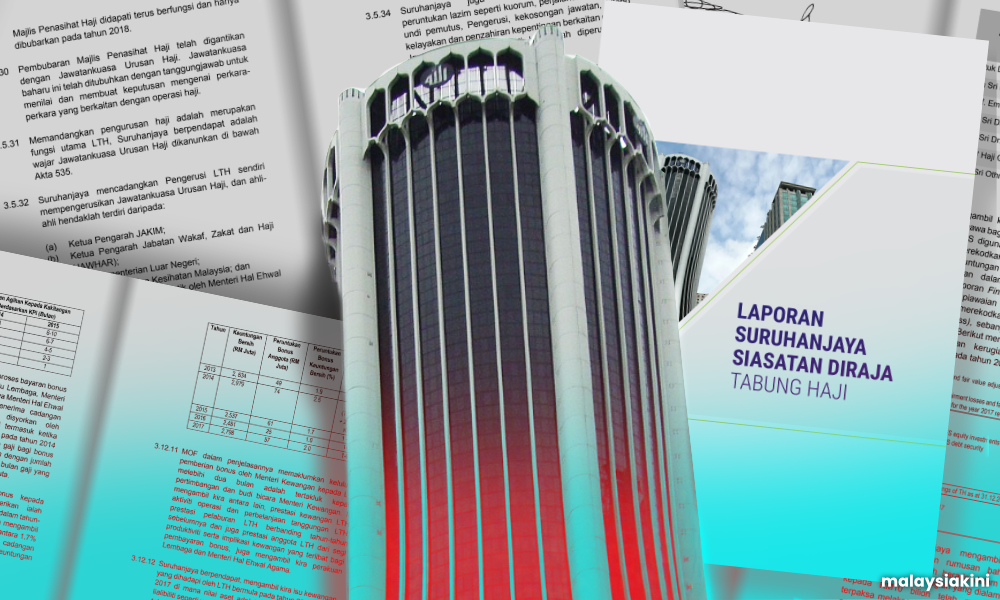
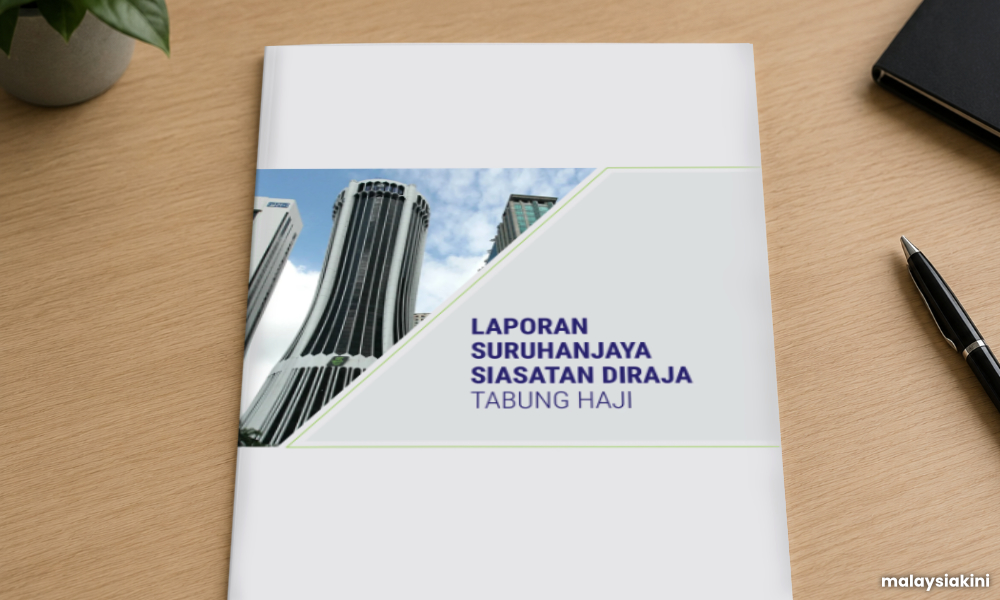
The RCI found that Tabung Haji should have reported a RM1.4 billion loss in 2017, rather than the RM3.4 billion profit it reported.
It also found that political considerations influenced decisions on hibah, haj payments, and financial assistance.
Losses and impairments were not properly recognised, while hibah was paid despite the institution’s deteriorating financial position.
This
wasn’t a one-year accident. The financial crisis stretched back to
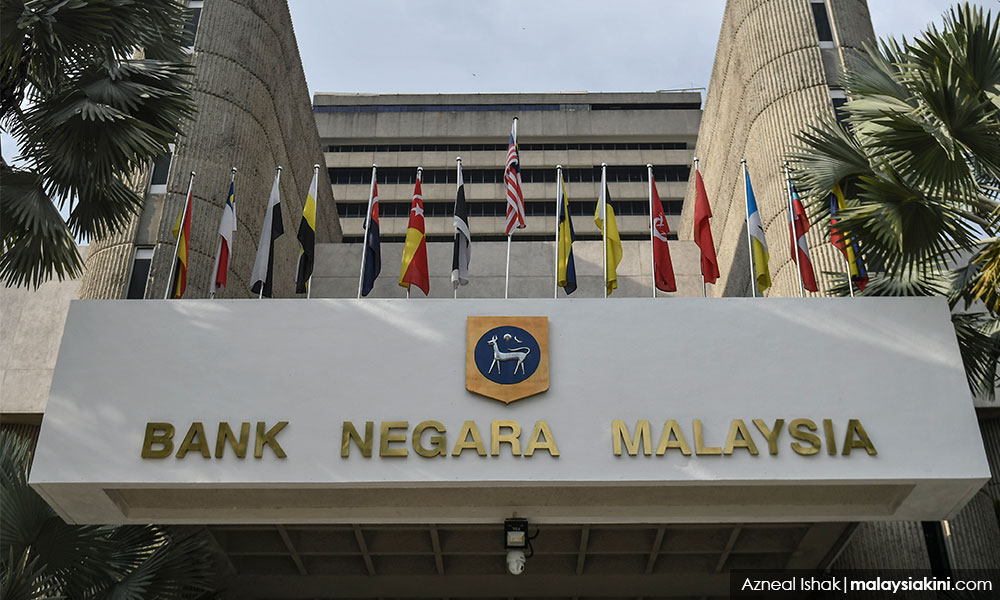
2014, and Bank Negara reportedly issued five warnings between 2014 and
2016.
So who received those warnings? More importantly, why wasn’t the problem stopped?
Was
Tabung Haji being run as a financially disciplined institution, or was
it being asked to serve political and social objectives that its
finances could not sustain?
How could an institution this important be allowed to decay across political administrations?
Billions in losses
The RCI identified 14 problematic investments which ultimately produced almost RM13 billion in losses.
It
recommended forensic audits into how those investments were made and
said those involved in the decisions should be held responsible for the
losses.
That
raises some very simple questions: Who approved them? Who carried out
the due diligence? Who raised concerns? Who ignored them? And who signed
off?
There is no need to accuse anyone of stealing money to demand answers.
Tabung
Haji paid about RM367.7 million in bonuses between 2010 and 2017. The
RCI found the payments excessively high and identified unauthorised
bonuses at its subsidiary as well.
This is where the story becomes more than financial.
Tabung
Haji exists to help Malaysian Muslims save to fulfil a fundamental
religious obligation - to perform the haj, one of the five pillars of
Islam.
So what does it say about an institution
entrusted with that sacred purpose when its financial position is
deteriorating while substantial bonuses are being paid?
For many depositors, this isn’t simply mismanagement. It is a betrayal of trust.
Uncomfortablequestions
But no theft does not mean no wrongdoing, and it does not mean good governance either.
An
institution can lose billions through reckless investments, poor
decisions, inadequate controls, political interference, and failure to
act on warnings.
The RCI found evidence of precisely these kinds of failures and another uncomfortable question.
The
auditor-general had already raised concerns in 2018 about Tabung Haji’s
impairment practices, including RM227.81 million in impairments that
had not been recorded.
So, why did it take a subsequent PwC review and the RCI to expose the much larger underlying problem?
Now the MACC is investigating possible corruption, abuse of power, falsification, and money laundering.
Let
the evidence determine whether criminal offences occurred, but even if
nobody is ultimately convicted of stealing a single ringgit, the
accountability question remains.
The RCI examined a period spanning successive governments, so this cannot simply become another political blame game.
The uncomfortable question is whether Malaysia’s political system repeatedly failed to protect Tabung Haji.
Bank
Negara warned. The financial position deteriorated. Investment losses
accumulated. Hibah continued. Bonuses were paid. The accounts were
audited. And eventually the government had to intervene.
So who was responsible?
So who was watching the institution? Who was responsible for acting when the warning lights were flashing?
Ultimately, ordinary people don’t get to make their losses disappear by calling them “accounting differences”.
The
RCI has now exposed almost RM13 billion in losses associated with 14
problematic investments, and Malaysians deserve to know who was
responsible.
Who knew? Who was warned? Who authorised
the investments? Who approved the hibah? Who approved the bonuses? Who
signed off on the accounts? Why weren’t the losses recognised earlier?
Why
weren’t Bank Negara’s warnings acted upon? Why did it take years for
the public to see the RCI report? Where is the accountability?
The
government must provide answers. If criminal wrongdoing is established,
will those responsible face the law? If it isn’t criminal, that cannot
mean everyone simply walks away from responsibility.
Tabung
Haji isn’t an ordinary investment company. It was entrusted with
something more valuable than money: people’s faith, savings, and hope of
fulfilling one of Islam’s five pillars.
For years,
Malaysians put aside their hard-earned savings believing Tabung Haji
would safeguard them and help them fulfil a fundamental religious
obligation.
That trust deserved better, and those entrusted with it owe Malaysians an explanation.
Imagine
putting passengers into a car after dinner, knowing the driver is unfit
to drive. The warning signs are there. People know about them. Yet
nobody stops the journey.
When the car crashes, we
don't just ask what went wrong. We ask: Who knew? Who was warned? Who
allowed the driver to continue? And who was responsible for the
passengers' safety?
That is the question Tabung Haji now raises. If nobody stole the money, who was responsible for losing it?