Rudyard Kipling"
“When you're left wounded on Afganistan's plains and
the women come out to cut up what remains, Just roll to your rifle
and blow out your brains,
And go to your God like a soldier”
General Douglas MacArthur"
“We are not retreating. We are advancing in another direction.”
“It is fatal to enter any war without the will to win it.” “Old soldiers never die; they just fade away.
“The soldier, above all other people, prays for peace, for he must suffer and be the deepest wounds and scars of war.”
“May God have mercy upon my enemies, because I won't .” “The object of war is not to die for your country but to make the other bastard die for his.
“Nobody ever defended, there is only attack and attack and attack some more.
“It is foolish and wrong to mourn the men who died. Rather we should thank God that such men lived.
The Soldier stood and faced God
Which must always come to pass
He hoped his shoes were shining
Just as bright as his brass
"Step forward you Soldier,
How shall I deal with you?
Have you always turned the other cheek?
To My Church have you been true?"
"No, Lord, I guess I ain't
Because those of us who carry guns
Can't always be a saint."
I've had to work on Sundays
And at times my talk was tough,
And sometimes I've been violent,
Because the world is awfully rough.
But, I never took a penny
That wasn't mine to keep.
Though I worked a lot of overtime
When the bills got just too steep,
The Soldier squared his shoulders and said
And I never passed a cry for help
Though at times I shook with fear,
And sometimes, God forgive me,
I've wept unmanly tears.
I know I don't deserve a place
Among the people here.
They never wanted me around
Except to calm their fears.
If you've a place for me here,
Lord, It needn't be so grand,
I never expected or had too much,
But if you don't, I'll understand."
There was silence all around the throne
Where the saints had often trod
As the Soldier waited quietly,
For the judgment of his God.
"Step forward now, you Soldier,
You've borne your burden well.
Walk peacefully on Heaven's streets,
You've done your time in Hell."
The first
problem is that this is not a non-Malay issue. Malays are frustrated
too, as are Chinese, Indians, Sabahans, and Sarawakians.
The cost of living
does not ask your race before emptying your wallet. Corruption does not
ask your race before damaging public trust. Poor governance does not
ask your race before affecting your daily life.
So why are we still talking about frustration through racial lenses? Leong should know better.
For
decades, politicians told us that we are one nation. Yet whenever
problems arise, we are immediately divided into Malay concerns, Chinese
concerns, Indian concerns, and non-Malay concerns.
Perhaps one reason Malaysia struggles to move beyond race is that our politics keeps dragging us back into it.
Then
there is the economy. Leong points to gross domestic product (GDP)
growth, foreign investment, a stronger ringgit and record tourist
arrivals. Good to know these, but ordinary Malaysians do not live inside GDP statistics.
They
live in the space between payday and the next bill. They see the
economy every time they buy groceries, pay rent, settle their utility
bills, or wonder whether their income will stretch to the end of the
month.
A mother buying groceries cannot pay with GDP
growth. A retiree cannot settle his electricity bill with foreign
investment figures.
Alwaysgetting there but not quite there
His
article also asks for patience, that reforms take time, coalitions are
complicated, bureaucracies are slow, and institutions resist change.
All
true, but Malaysians did not elect a government to explain obstacles
with endless spin. They elected a government to overcome them.
Coalition
politics may explain the delay. They do not excuse it. Institutional
constraints may explain the difficulty. They do not replace delivery.
At
some point, a reason stops being a reason. It becomes an excuse, and
that is why many voters are asking a simple question: Where are the
reforms?
We don’t need the endless speeches,
announcements, and promises of reform because reform cannot permanently
exist in the future tense. It cannot always be “coming soon”.
Madani’s reforms are like a bus that is always about to reach the next stop, but never does.
Pussyfooting around racial issues
The
same applies to religious and cultural issues. Citizens are told these
matters are sensitive. We know they are, but sensitivity cannot become a
substitute for fairness.
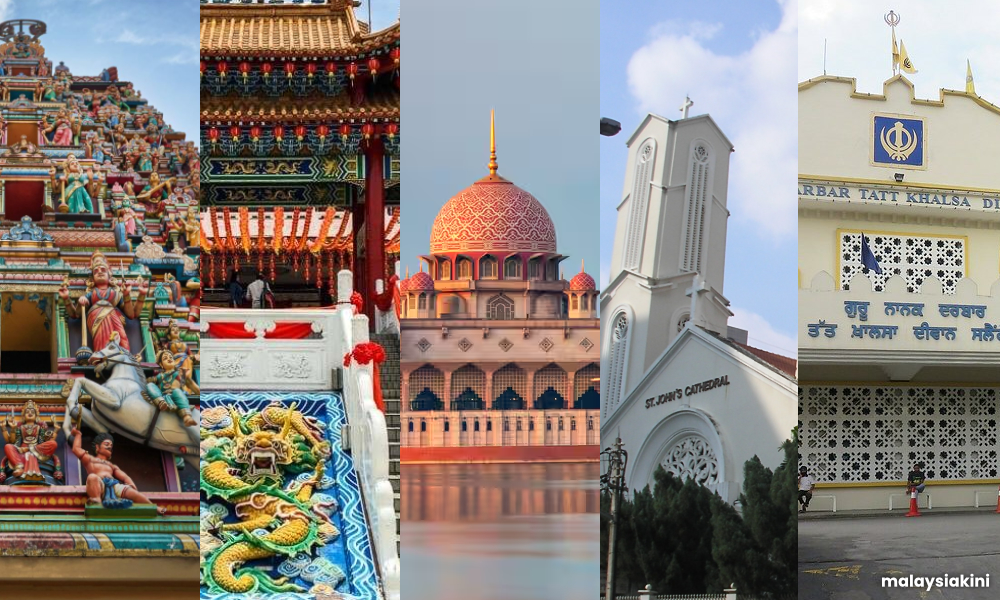
When temples are relocated, when non-Muslim places of worship face restrictions and when questions arise over whether a church or temple should be lower than a mosque, citizens have every right to ask why.
Why
should the height of another person’s building threaten the strength of
one’s faith? A confident faith does not require a tape measure.
Right to ask questions
And while we are on the subject of questions, citizens also have every right to question government decisions, especially about public spending, procurement, governance, or competence.
That is not extremism. That is simply citizenship.
Democracy is not strengthened when people stop asking questions. It is strengthened by answers and facts, not debates, police reports, and enforcement language.
Take the littoral combat ships project. Billions of ringgits were spent, years passed, deadlines missed, explanations offered, and then even more explanations followed.
The public kept asking the same question: Where are the ships? Unsurprisingly, the answers have always been more “explanations”.
A US Navy LCS
Then
there is Boustead Naval Shipyard Sdn Bhd. Taxpayers’ money is not a
bottomless pit of bailout money. Citizens are entitled to ask why money
intended for national defence appears entangled with corporate rescue
exercises and debt problems.
We are justified in asking at what point does public money stop serving the public and start serving institutional failure?
Then
there is corruption. Ordinary Malaysians are repeatedly told nobody is
above the law, but high-profile cases often seem to end with acquittals,
discharge not amounting to acquittals (DNAA), reduced sentences, reduced fines, compounds, or pardons.
Each case may have its own legal explanation, but public trust is built on consistency, which many people feel is missing.
The same applies to concerns about powerful networks operating behind the scenes. Take your pick: Corporate interests, political patronage, procurement ecosystems, cartels, and cases that fade away.
Whether these concerns are justified or not, they exist, and ignoring them will not make them disappear.
Many Malaysians share legitimate concerns about extremism, but fear cannot become a government’s permanent campaign strategy.
A government cannot endlessly ask voters to support it because the alternative may be worse.
So we will ask this question. “What have you done with the opportunity we already gave you?”
We
deserve an answer, and we do not need another warning from politicians,
because the biggest mistake they make is assuming public frustration
comes from misunderstanding.
More often, it comes
from understanding perfectly well. We understand what was promised, what
was delivered, and the gap in between.
Explanations
are not achievements, and when the same explanations are repeated year
after year, they stop sounding like explanations. They are excuses.
Leong
said that we are voting for ourselves and our children, and that not
voting means surrendering our power to those who may not have our best
interests at heart.
That is the theory, because our
experience is simple: votes are repeatedly used to return to power
people who later prove they do not have our best interests at heart.