Rudyard Kipling"
“When you're left wounded on Afganistan's plains and
the women come out to cut up what remains, Just roll to your rifle
and blow out your brains,
And go to your God like a soldier”
General Douglas MacArthur"
“We are not retreating. We are advancing in another direction.”
“It is fatal to enter any war without the will to win it.” “Old soldiers never die; they just fade away.
“The soldier, above all other people, prays for peace, for he must suffer and be the deepest wounds and scars of war.”
“May God have mercy upon my enemies, because I won't .” “The object of war is not to die for your country but to make the other bastard die for his.
“Nobody ever defended, there is only attack and attack and attack some more.
“It is foolish and wrong to mourn the men who died. Rather we should thank God that such men lived.
The Soldier stood and faced God
Which must always come to pass
He hoped his shoes were shining
Just as bright as his brass
"Step forward you Soldier,
How shall I deal with you?
Have you always turned the other cheek?
To My Church have you been true?"
"No, Lord, I guess I ain't
Because those of us who carry guns
Can't always be a saint."
I've had to work on Sundays
And at times my talk was tough,
And sometimes I've been violent,
Because the world is awfully rough.
But, I never took a penny
That wasn't mine to keep.
Though I worked a lot of overtime
When the bills got just too steep,
The Soldier squared his shoulders and said
And I never passed a cry for help
Though at times I shook with fear,
And sometimes, God forgive me,
I've wept unmanly tears.
I know I don't deserve a place
Among the people here.
They never wanted me around
Except to calm their fears.
If you've a place for me here,
Lord, It needn't be so grand,
I never expected or had too much,
But if you don't, I'll understand."
There was silence all around the throne
Where the saints had often trod
As the Soldier waited quietly,
For the judgment of his God.
"Step forward now, you Soldier,
You've borne your burden well.
Walk peacefully on Heaven's streets,
You've done your time in Hell."
Who's the most powerful man in Malaysia? By Mariam Mokhtar
Friday, March 13, 2026
Malaysiakini : The MACC is the country’s principal anti-corruption body, responsible
for investigating everyone else. When its chief comes under scrutiny, a
contradiction arises: who investigates the investigator?
Possible mechanisms include the Attorney-General’s Chambers under Dusuki Mokhtar, the Chief Secretary of the Public Service Department under Shamsul Azri Abu Bakar, parliamentary oversight committees, or a royal commission of inquiry.
Disappointingly, the government has chosen
to treat this as a civil service disciplinary matter, leaving the chief
secretary to decide the next steps. This cautious move preserves
institutional appearance and avoids fully confronting the legal and
ethical implications.
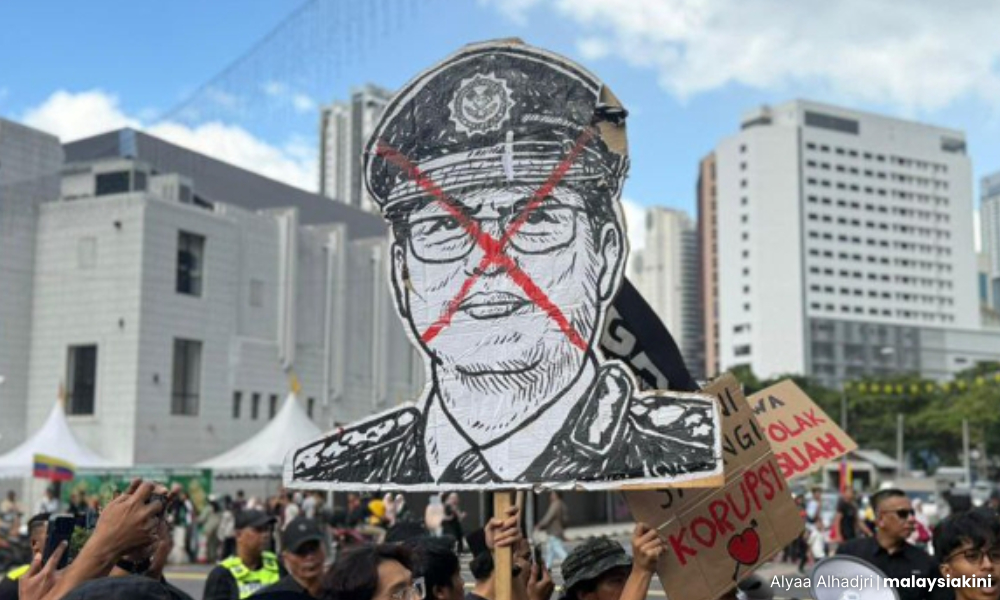
Minister Fahmi Fadzil's reluctance to
disclose further details of the investigation is unacceptable. How is
this a disciplinary issue and not a criminal corruption investigation?
This hesitancy has arisen because the investigator is being
investigated.
The Madani administration brands itself as a
reformist government, and the prime minister knows that the Azam issue
functions as a political trap: An aggressive investigation could expose
weaknesses within the MACC, undermine the agency’s credibility, and give
opposition groups leverage to claim systemic corruption.
On the other hand, to delay or dilute the investigation,
reinforces public perceptions of insider protection much like a
members-only club, eroding trust and making the GE14 reform promises
look hollow.
Paradox
Unsurprisingly, the
political instinct has been to delay, redirect, or diffuse pressure.
Successive governments tend to use this classic tactic to avoid immediate accountability.
Allegations reported by Bloomberg describe a network of business figures allegedly colluding
with enforcement officers to manipulate companies. Politically, this
reframes the story from “Did the MACC chief break rules?” to “Is there a
broader corporate conspiracy?”
While
the narrative appears to show decisive action against systemic
corruption, it also diffuses pressure on Azam personally. Talking about a
bigger corruption investigation makes the government look active, but
also reduces the pressure to answer the specific questions about Azam.
Here
lies the paradox: the MACC is simultaneously accused of selectively
undermining certain businesses while protecting others, yet the
perceived threat of the ‘corporate mafia’ functions as a bogeyman.
Companies
and officials not directly involved behave cautiously, fearing
scrutiny, which reinforces elite control and maintains the appearance of
oversight. In other words, the elites stay protected, and the rest walk
on eggshells. It may look like oversight is working, even if it’s just a
show.
Cast
our minds back to the 2018 general election, which ended decades of
uninterrupted Umno-Baru rule. Today, the ruling coalition still includes
Umno-Baru elements, with many leaders retaining their Umno-Baru DNA
despite belonging to other parties.
Reformers must juggle
power-sharing and institutional integrity. In doing so, they hesitate to
pursue major investigations that might rock elite networks. Coalition
politics and influential officials often undermine well-intentioned
reforms.
Ask any Malaysian, and they will say that they expect the
rule of law, independent institutions and anti-corruption enforcement
in the country. Delays in the Azam investigation feed perceptions of double standards, institutional protection, political survival and selfish self-interests overriding reform.
Trust
in governance, both on the domestic and international fronts, depends
on visible, credible enforcement, especially at the top. Not listening
to the rakyat is why public frustration is growing.
Stakes are high
The
core paradox boils down to this: systems versus powerful individuals.
Investigating systemic corruption, such as the alleged corporate mafia,
is politically easier than investigating the head of the MACC.
Selective
enforcement, structural protection, and coalition politics converge to
create an environment where the most powerful man in Malaysia can
operate with relative impunity, while ordinary citizens and businesses
face the bogeyman of systemic oversight.
The stakes are high, and a transparent, high-profile investigation would:
Reassert MACC independence and restore domestic credibility,
Boost investor confidence by signalling fair enforcement and a level playing field,
Strengthen the reformist image of the Madani administration ahead of GE16, and
Ensure governance is predictable, transparent, and resilient.
Failing
to act decisively risks entrenching cynicism, undermining public trust,
and sending the wrong signal internationally: that Malaysia tolerates
selective enforcement at the top while expecting compliance from
everyone else.
A rigorous, transparent investigation
into Azam and a full probe of the MACC would carry substantial
benefits. Public trust would be restored. Institutional independence
would be strengthened, and show that the MACC is not a political tool.
Investor confidence would be enhanced.
Perhaps, more importantly
for the leaders of the Madani administration, whose reputations are
declining, they would gain political advantage ahead of GE16.
Decisive
action would signal courage and principle, strengthen the coalition’s
reformist image, and counter perceptions that parties such as DAP are
passive or disengaged.
For Anwar, the choice is stark: Inaction? Or act decisively to uphold transparency and the rule of law?
For
the nation, the implications, political, economic, and reputational,
could not be higher. Malaysians will not tolerate the most powerful man
in Malaysia remaining beyond meaningful accountability.
Editor's note:Amid allegations that its officers are entangled in a “corporate mafia” scheme, the MACC on Feb 24 issued a second firm denial and dismissed the claims as baseless.